Yard Drainage Solutions Guide
How to identify, understand, and solve drainage problems in your Lowcountry yard.
Solving Yard Drainage Problems in the South Carolina Lowcountry
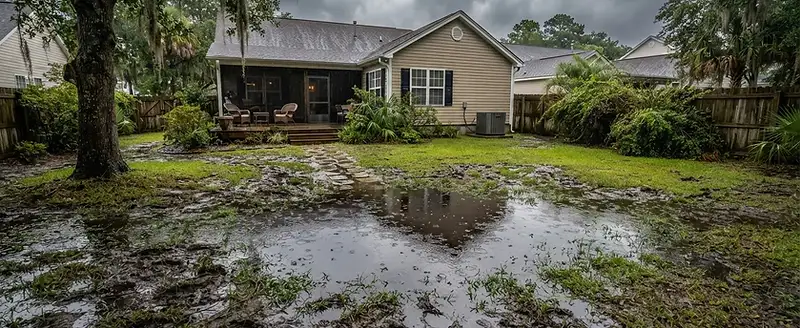
Standing water in your yard is more than a nuisance. It kills grass, damages plantings, attracts mosquitoes, erodes soil, and—most seriously—can threaten your home's foundation. In the South Carolina Lowcountry, drainage problems are remarkably common. Our flat terrain, sandy topsoil sitting over dense clay or hardpan, and heavy seasonal rainfall create the perfect conditions for water to collect and stay. Newer communities like Nexton, Summers Corner, and Cane Bay are especially prone as final grading continues to settle years after construction.
The good news is that nearly every drainage problem has a solution. The key is understanding where the water comes from, how it moves across your property, and where it collects. This guide from Back Tees Irrigation & Landscape explains the most common drainage issues Lowcountry homeowners face, the solutions that work, and how to know when it is time to call a professional. Whether you are dealing with a soggy lawn, water near your foundation, or runoff from your roof flooding your beds, the right drainage plan can transform your yard from a problem area into a healthy, usable outdoor space.
Signs Your Yard Has a Drainage Problem
Drainage issues rarely resolve themselves. If you notice any of these warning signs, a professional evaluation can identify the cause and the right solution before the problem worsens.
Drainage Solutions That Work in the Lowcountry
French Drains
A gravel-filled trench with a perforated pipe that collects subsurface water and redirects it away from problem areas. French drains are ideal for soggy lawns, low spots, and water that seeps through the soil rather than pooling on the surface. Proper slope, clean gravel, and filter fabric ensure the system functions for years without clogging.
Surface & Channel Drains
Grates and channels installed at ground level capture water that collects on hardscape surfaces—patios, driveways, walkways—and move it through solid pipe to a safe discharge point. These are essential for flat Lowcountry yards where water has no natural path to flow away from your home.
Downspout & Gutter Management
Roof runoff is one of the most common causes of yard flooding near foundations. Extending downspouts underground and connecting them to drainage lines carries roof water safely away from your home and landscape beds, preventing erosion and foundation moisture.
Grading & Swale Corrections
Sometimes the solution is reshaping the ground rather than installing pipe. Regrading low spots and creating shallow swales guides water naturally toward a safe outlet, reducing the need for extensive underground systems and restoring proper flow across your property.
Many properties need more than one type of solution. We often combine French drains, surface drains, downspout lines, and grading corrections into a single integrated drainage plan—addressing water at every point from where it enters your property to where it exits.
Why Professional Drainage Installation Matters
A drainage system is only as effective as its installation. A French drain installed without proper slope will not flow. One without filter fabric will clog within a season or two. A surface drain with undersized pipe will overflow in the first heavy downpour. In the Lowcountry, where summer storms can drop inches of rain in an hour, your drainage system has to be built right the first time.
Professional installation means correct depth and slope, quality perforated pipe and clean gravel, filter fabric to prevent clogging, and a discharge point that moves water safely away from your home and your neighbors' properties. It also means evaluating your entire property—not just the obvious wet spot—so the solution addresses the root cause rather than shifting the problem to another area of your yard. At Back Tees, we handle irrigation, drainage, landscaping, and hardscaping together, which means your drainage plan integrates with your irrigation system and landscape design for a cohesive result.
Drainage Frequently Asked Questions
Answers to the questions we hear most from Lowcountry homeowners.
A French drain addresses subsurface water—water that moves through the soil and collects underground. A surface drain captures water that pools on top of the ground, especially on hardscape surfaces like patios and driveways. Many Lowcountry properties benefit from both, and a professional evaluation determines the right combination for your yard.
Is Water Damaging Your Yard?
Contact Back Tees for a drainage evaluation and a customized solution for your Lowcountry property.