Cane Bay's new construction means settling grade and drainage problems are common. Learn the solutions that fix standing water, soggy lawns, and foundation runoff.
The Settling Grade Problem in Cane Bay
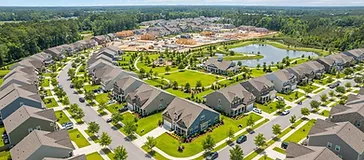
Cane Bay's rapid growth means thousands of homes have been built on soil that was graded during construction and is still settling. When a home is built, the soil around it is moved, compacted, and shaped to direct water away from the foundation. Over the following months and years, that soil settles unevenly—more in some areas, less in others—and the carefully shaped grading begins to change. Low spots form, slopes reverse, and water that once drained cleanly starts to collect. This is not a construction defect; it is a normal consequence of building on soil that was disturbed, and it is something nearly every new Cane Bay homeowner will deal with to some degree.
Signs Your Yard Has a Settling Grade Issue
The signs of settling grade are usually obvious after a heavy rain. Water sits in a low area of the lawn for hours or days instead of absorbing or draining away. The soil near the foundation stays wet longer than the rest of the yard. A downspout exit point becomes a persistently soggy patch. You may notice turf thinning or dying in the wet areas while the rest of the lawn looks fine. If any of these sound familiar, the cause is almost certainly grading and drainage, not irrigation—though the two are related and both may need attention.
Solution 1: French Drains at Low Points
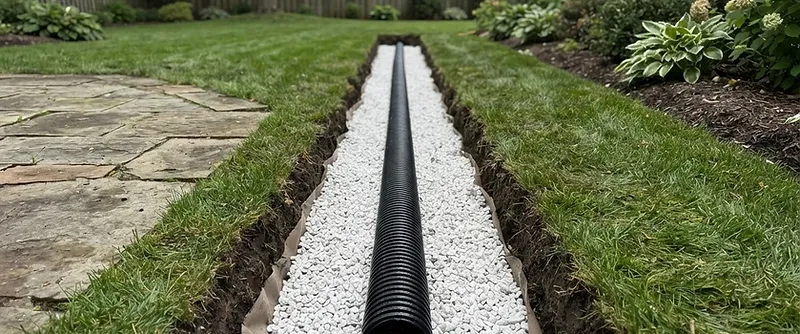
When water collects in a specific low spot, a French drain installed at that point is often the most effective solution. The drain intercepts water as it flows into the low area, carries it through a perforated pipe surrounded by gravel, and discharges it at a lower, safe point on the property. Because the drain works underground, it does not change the appearance of your Cane Bay lawn once it is installed and the turf has recovered. The key is identifying the right location and discharge point, which requires evaluating how water moves across your specific yard.
Solution 2: Surface Drains for Heavy Flow
For areas where a large volume of water collects quickly during heavy rain, a surface drain—also called a catch basin—may be more effective than a French drain. A surface drain has a grated opening at the low point that collects water and pipes it away through solid pipe. This is often the better choice for the lowest point in a Cane Bay yard where runoff from surrounding higher ground converges. In many cases, a combination of a surface drain at the collection point and a French drain along the flow path provides the most complete solution.
Solution 3: Downspout Management
Roof runoff is one of the largest contributors to yard saturation in new construction, and it is often overlooked. A single downspout can dump dozens of gallons of water at the base of your home during a Lowcountry thunderstorm, and if that water has nowhere to go, it soaks into the surrounding soil and creates a persistent wet area. Connecting downspouts to underground pipes that carry roof water to a discharge point away from the house and the lawn is one of the highest-impact, lowest-cost drainage improvements for a Cane Bay home.
Solution 4: Regrading Settled Areas
In some cases, the most effective solution is to correct the grading itself. If the soil near the foundation has settled and is now sloping toward the house instead of away, regrading that area to restore a positive slope is essential to protect the foundation. If a low spot in the lawn is shallow and there is a lower area to direct water toward, light regrading may resolve the issue without a drain. Regrading is usually combined with other solutions rather than used alone, and it is most effective when done early, before the settling has caused significant turf damage.
Solution 5: Addressing Compacted and Poorly Draining Soil
Sometimes the drainage problem is not the grading but the soil itself. Cane Bay's construction-disturbed soil can be compacted in areas, and compacted soil sheds water instead of absorbing it. Aeration, soil amendment with organic matter, and in severe cases removal and replacement of the compacted layer can restore the soil's ability to drain. This is often paired with a drainage solution, because improving soil infiltration alone will not solve a problem caused by a low spot or a reverse slope. We evaluate whether your issue is grading, soil, or both before recommending a solution.
Building a Complete Drainage Plan
Effective drainage in a new Cane Bay yard is rarely a single fix—it is usually a combination of solutions designed to work together based on how water actually moves across your property. Back Tees Irrigation & Landscape evaluates every drainage issue in person, identifies the root cause, and designs a plan that may include French drains, surface drains, downspout management, regrading, and soil improvement. If your Cane Bay yard has drainage problems, request an estimate and we will help you build a solution that works at the source.
Need help with your Cane Bay property?
Back Tees Irrigation & Landscape provides irrigation, drainage, sod, and landscaping services for Cane Bay homeowners. We are an independent local company and are not affiliated with Cane Bay, its developers, builders, or homeowners' associations.