
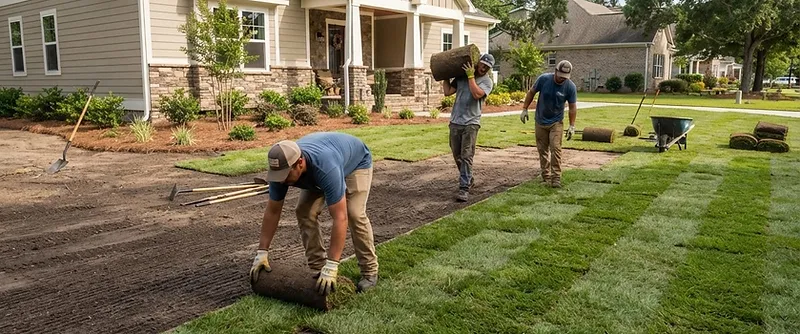
New sod in Cane Bay needs the right watering schedule to establish deep roots and survive Lowcountry heat. Learn the phases of establishment and how to avoid common mistakes.
Why Sod Establishment Is Different in Cane Bay
Cane Bay's new homes typically come with fresh sod laid over construction-graded soil, and that combination creates specific establishment challenges. The sod itself is mature grass, but its roots have been cut short for harvesting and need to grow down into the soil beneath it. The soil it is rooting into was disturbed during construction and may be compacted, layered, or mixed with fill material. And the Lowcountry climate delivers intense heat and heavy rainfall in the same season, which means the new lawn can be stressed by drought and saturated by rain in the same week. Getting the watering right during establishment is what determines whether that sod becomes a healthy, permanent lawn or struggles for years.
Phase One: Keeping the Sod Alive (Weeks 1–2)
The first goal of watering new sod is simple: keep it and the soil beneath it consistently moist so the roots begin to grow down. During the first two weeks, water one to three times per day with short cycles that moisten the sod and the top inch of soil without creating runoff. In the heat of a Cane Bay summer, a brief midday cycle may be needed to keep the sod from drying out. Lift a corner of the sod to check that the soil beneath is damp. The sod should feel cool and moist, not dry and warm. If the edges are curling or shrinking, it is not getting enough water.
Phase Two: Encouraging Deep Roots (Weeks 3–6)
Once the sod has begun to root—usually by the third week—you shift the goal from keeping the surface moist to encouraging roots to grow deeper. Reduce watering frequency gradually while increasing the duration of each cycle. Move from two or three daily cycles to one longer morning session, then to every other day. This forces the roots to grow down in search of moisture rather than staying shallow near the surface, where they are vulnerable to heat and drought. You can test rooting by gently tugging on the sod; if it resists, the roots are anchoring into the soil.
Phase Three: Transition to Established Schedule (Weeks 6–12)
By six weeks, most Cane Bay lawns are rooted enough to transition to a normal established schedule. Water two to three times per week in the early morning, delivering enough to wet the soil to a depth of four to six inches. You can check depth by running a cycle and then probing the soil with a screwdriver; if it slides in easily to several inches, the watering is adequate. The most common mistake at this stage is continuing the frequent, shallow establishment schedule well past the point where the lawn needs it, which keeps roots shallow and promotes fungal disease in the Lowcountry humidity.
Common Establishment Mistakes to Avoid
Several mistakes are common in new Cane Bay lawns. Watering in the evening leaves the lawn wet overnight and encourages fungal disease—always water in the early morning. Continuing the establishment schedule too long keeps roots shallow and wastes water. Ignoring coverage gaps means brown patches appear in summer when a head is not reaching. Overwatering to compensate for a drainage problem does not fix the problem and makes it worse. And assuming the builder-installed irrigation is correctly programmed for establishment often means the schedule is generic rather than tailored to your lawn's actual conditions. Each of these is avoidable with attention and, when needed, a professional audit.
Choosing the Right Grass for Cane Bay
The grass variety you establish matters as much as the watering schedule. Warm-season grasses are the right choice for the Lowcountry, but the specific variety should be selected based on your Cane Bay lot's sun exposure, soil, and maintenance preferences. Some varieties handle full sun and heat exceptionally well but need more water during establishment. Others are more drought-tolerant once established but slower to root. During a consultation, we help you understand the options and select a variety that will thrive on your property, and we time the irrigation schedule to match the establishment needs of that specific grass.
When Establishment Goes Wrong
If your new Cane Bay lawn is not establishing well—brown patches, curling edges, soggy areas, or uneven growth—the cause may be irrigation coverage, drainage, soil compaction, or a combination. The sooner the issue is identified, the easier and less expensive it is to correct. A lawn that struggles during establishment often never fully recovers without intervention, because the underlying cause continues to stress the grass. Back Tees Irrigation & Landscape helps Cane Bay homeowners diagnose and fix establishment problems, from irrigation adjustments to drainage corrections to sod replacement when needed. If your new lawn is struggling, request an estimate and we will help you get it back on track.
Need help with your Cane Bay property?
Back Tees Irrigation & Landscape provides irrigation, drainage, sod, and landscaping services for Cane Bay homeowners. We are an independent local company and are not affiliated with Cane Bay, its developers, builders, or homeowners' associations.